falling down the homelab rabbit hole
Published: November 8, 2026
Last Updated: November 8, 2026
It's been a while since I made a blog post (if anyone even reads this), but ever since then I've been working on a numerous amount of projects.
I created Hyperion, a distributed key-value
database using the hashicorp-raft SDK for consensus, Go cuz I like it (although maybe
I could've done it in C++ or Rust), as well as Docker and Kubernetes (kind) for different
deployment options. I even implemented chaos testing, but enough about that. If you want
to go check it out, feel free to check my GitHub!
Anyways, back to the point of this blog post. Something I've recently built was my own personal homelab server. It started around the beginning/middle of July, I think, when I got a bright idea to try and make my own homelab. I had a friend who has his own NAS and his own homelab where he hosts a bunch of cool stuff, so I thought it would be cool to make my own too.
Falling... or Ascending?
Suddenly, I fell down a rabbit hole... and I think for the next month or so I got Instagram reels, YouTube shorts, and I even started reading Reddit threads (you know it's cooked when you do this), to the point where I went from "hmm..." to researching "diff between NAS and homelab"
I learnt a whole lotta sh*t from July-August. Technically, I knew these tools and software before; I just never used them. And that's the great thing about building, IMO: you actually learn by doing. Things like Tailscale, Cloudflare Tunnel, Proxmox VE, LXC containers, and VMs—I never really worked in "creating" with these tools before, and finally was piecing everything together.
Kubernetes, because why not?
This is probably one of the weird points of the project. Kubernetes is probably overkill for what I'm doing, especially since I'm technically only using one physical machine. There isn't really any fault tolerance or high availability for my services, because the entire cluster still depends on that one physical host. But what stops me from learning because I want to?
Anyways, going into this project, I had experience with Kubernetes before, but only for local development. I wanted to understand the complexity better and basically remove that "oh, it's hard to learn" factor. So, I decided to use Kubernetes (more specifically, k3s) to orchestrate all my services, including this website and private services like Immich, Prometheus, and Grafana. I learnt a lot of things, and honestly, it was an eye-opening experience, to say the least.
I could've just used 15+ Linux Containers (LXC) on Proxmox instead, or one of the other orchestration tools I considered, such as Podman, Compose, Swarm, or Nomad. But, Kubernetes felt like the best fit for what I wanted to learn and build.
Buying the hardware
Fast-forward to around the midpoint of the third week of August: I said, "f*ck it, I'm buying a mini PC, idc." So, I bought a BOSGAME P5 Pro mini PC (~$900 LOL). It's okay, gotta use my internship money somewhere 😭. Looking back to this moment, I'm grateful for my past self for actually taking the step. This has been the greatest engineering learning experience that changed my whole outlook of my career, and I don't even think I'm exaggerating.
Once I got the mini PC, I realized the easy part was done. It might've been the most expensive part, but the hardware was there. It was actually the software that was the hardest part. For 2–3 weeks (end of August to mid-September), I realized the full, sheer fundamentals of computer science and how it all came into play. This ranges from networking, operating systems, computer architecture, to security, and it all finally started to make sense.
I know this sounds like I've been living under a rock—and yes, I've worked with servers and hardware (I made my own PC) before—but maybe it's because I had the intent of creating my OWN server. With my money, my hardware, and this time, taking something I learnt from school to the real world.
How this changed my journey
It made me appreciate university, and maybe the past 5 years actually accumulated to something. It only felt like yesterday when I went to my first hackathon (shoutout UofTHacks 2023), where all I knew was Python and Java. Just the languages, not even frameworks (I didn't even know what CSS was LOL).
More than anything, this project made a lot of things feel less abstract. I wasn't just learning concepts anymore; I was making tradeoffs, debugging failures, and figuring out why something broke instead of just moving on to the next assignment. I had to take ownership of the entire system, from the hardware and networking to the applications running on top of it.
This rewired my brain to think more like a systems and infrastructure engineer, rather than some guy that writes code. Or I guess nowadays, prompting fifteen Claude subagents on a single terminal 😭
I still have a lot to learn, but building something that I actually use made the learning feel way more real. Maybe the next steps would be buying more mini PCs, a server rack, mount some GPUs... Local LLMs go brr 👀👀 The rabbit hole has just begun...
Besides that, I hope this inspires you to improve your craft, no matter what it is, or how long it takes. If you made it this far, thanks for the read :)
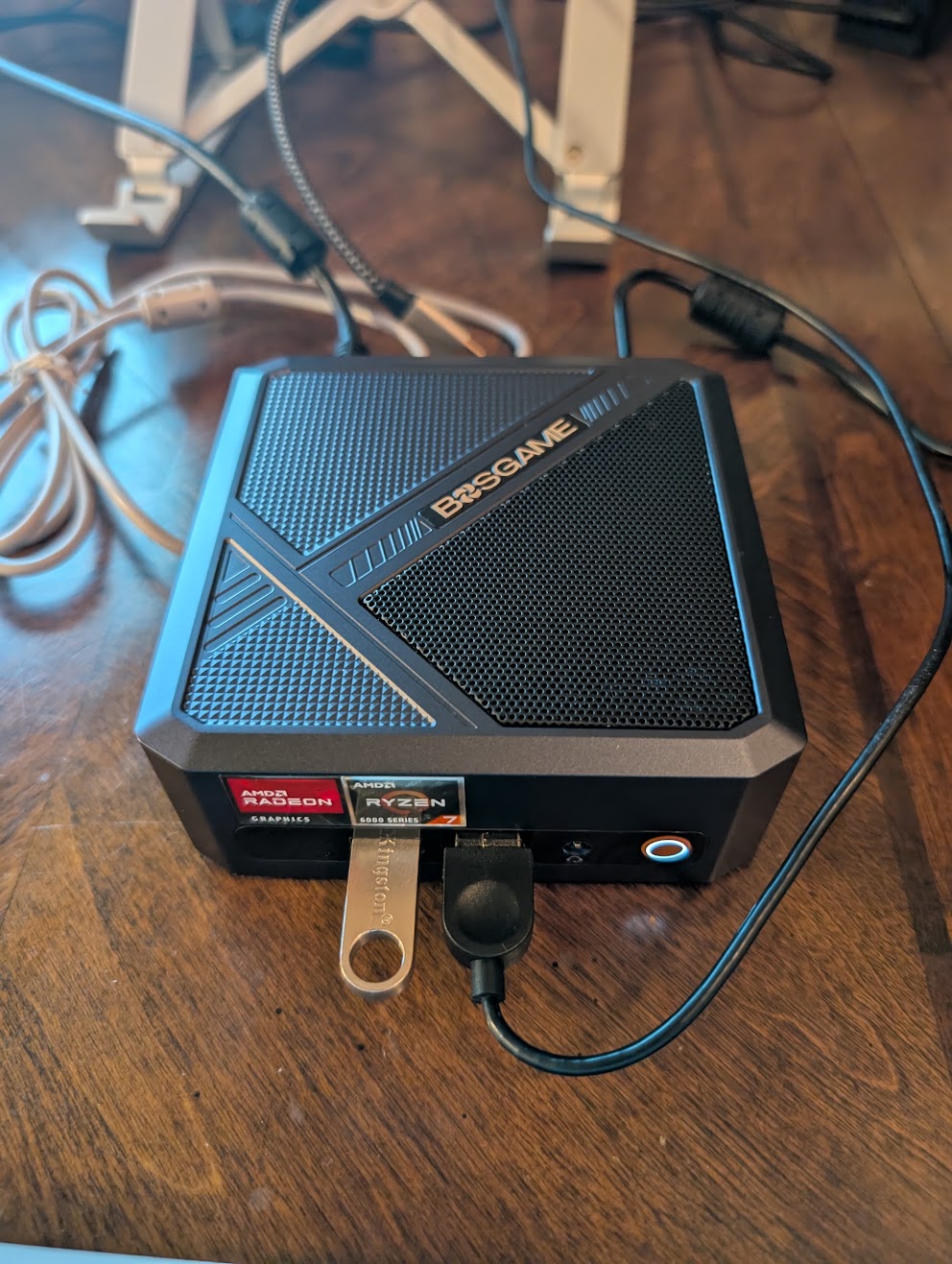
The homelab, first being worked on.
Under the hood
As for the technical details and the nerds out there, it's a single physical-node Proxmox VE server running three VMs that make up the k3s cluster: one control-plane VM and two worker VMs. It also has a fourth VM for game servers, which runs outside Kubernetes.
The k3s cluster runs services like Grafana, Prometheus, Loki, Immich, Gitea, Headlamp, this website and its API, as well as other side projects. I even had a 2-week modded Minecraft phase shortly after creating the homelab with my friends, hosted on the separate game-server VM with Docker.
There isn't a VLAN or anything (I don't have a managed Ethernet switch), but there is a private Proxmox network for K3s node traffic, while Flannel handles pod-to-pod traffic inside the cluster. The Proxmox firewall allows only the required ports from the appropriate networks and blocks other incoming traffic. I also don't forward Proxmox, SSH, Kubernetes, database, or private-service ports through my router.
Instead, I use Tailscale for private access to the homelab, while Cloudflare Tunnel exposes public services (like this website) without exposing a port on my router. The Minecraft server uses playit.gg for public game-server access.